

 Explore Worlds
 Find Life
 Defend Earth

MMX, Japan’s Martian Moons eXploration mission
Highlights
- Japan’s Martian Moons eXploration (MMX) mission aims to bring back the first-ever samples from Phobos, a moon of Mars, to explore what the Solar System was like shortly before life arose on Earth.
- MMX carries a sample collection device that The Planetary Society helped make happen.
- The mission will launch on Oct. 19, 2026, and aims to return samples from Phobos to Earth in 2031.
Why bring back samples from Phobos?
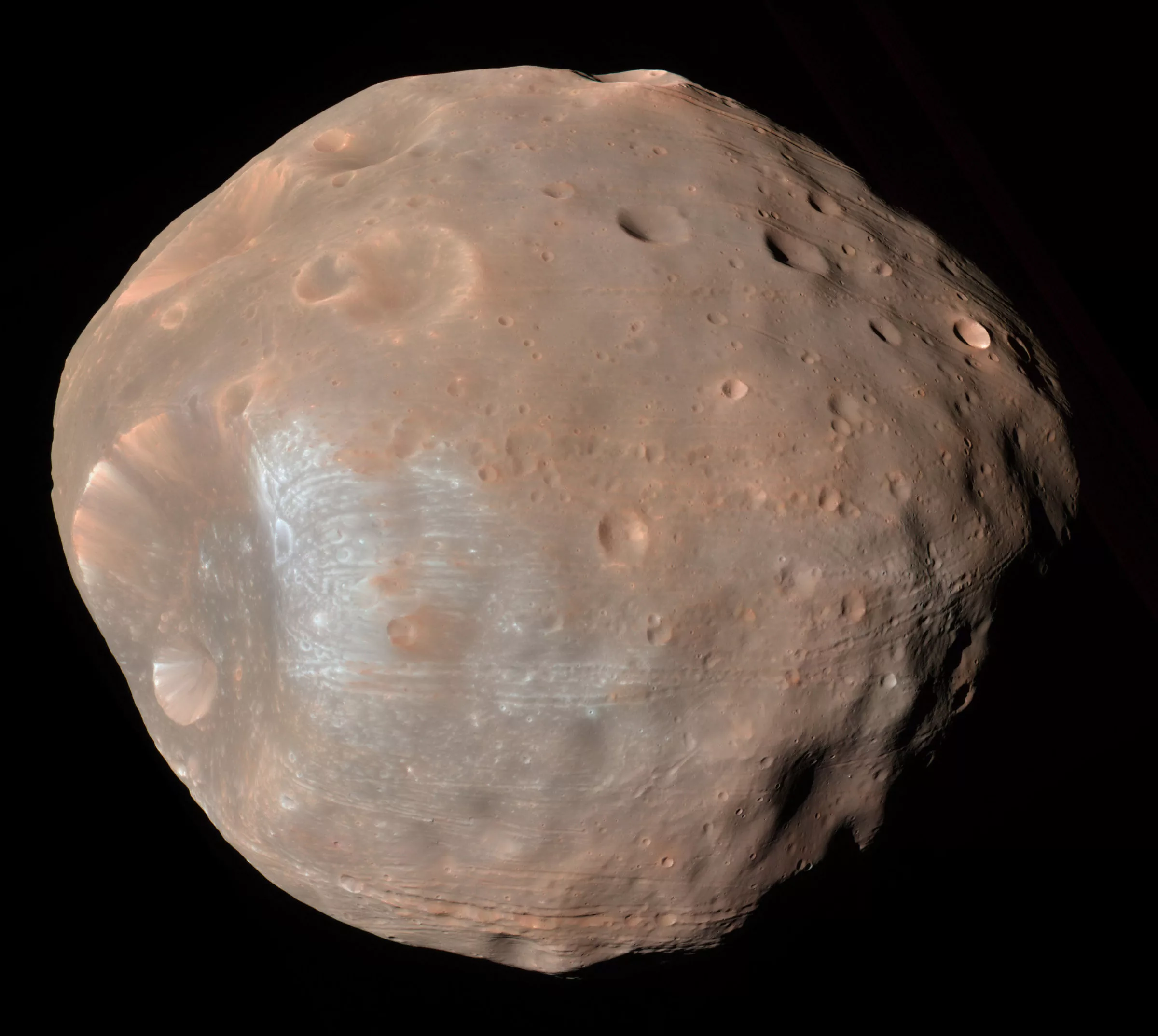
Though about ten missions have successfully landed on Mars, no spacecraft has ever touched down on either of its moons, Phobos and Deimos. At first glance, neither world may seem spectacular. They are small and lumpy, with Phobos measuring roughly 22 kilometers (14 miles) across, while Deimos is even more compact at about 13 kilometers (8 miles) wide.

But Phobos and Deimos offer windows into the Solar System's ancient past. They likely formed from debris smashed off of Mars billions of years ago, when large numbers of asteroids and comets bombarded the inner planets and possibly brought with them water and other chemical ingredients for life as we know it. Debris from those collisions could have settled into rings around Mars, then clumped together into moons.
Scientists predict that Phobos will transform into a ring around Mars in roughly 20-50 million years, when it spirals close enough to Mars to be torn apart by the red planet's gravity. Some researchers argue that, afterward, the ring will collapse together to form another moon, and that Phobos has experienced this dramatic cycle multiple times.
Figuring out how Phobos and Deimos formed would help humanity better understand what happened in the inner Solar System before life arose on Earth. Japan’s Martian Moons eXploration mission, or MMX, will survey the moons and bring a sample of Phobos back to Earth. If the moons came from a giant impact on Mars, the resulting heat and energy should have removed most traces of water on both worlds. If they did not form from impacts with Mars but are instead captured asteroids, Phobos and Deimos should have substantial water and organic materials like we find on similar small worlds.
By bringing back samples, MMX will allow scientists to explore pieces of the Mars system using equipment that is too large, heavy, and power-hungry to fly on spacecraft. And to grab them, MMX will test a new sample collection technology — one The Planetary Society helped enable.
How MMX will pick up pieces of another world
MMX will use two different instruments to try collecting samples from Phobos: C Sampler, a robotic-arm-mounted corer, and P Sampler, which works by releasing pressurized gas to kick up surface materials that then travel through a tube into a collection container.
That instrument is a derivative of Honeybee Robotics’ PlanetVac, a technology that The Planetary Society supported at multiple points in its development. PlanetVac originally came to the attention of our Science and Technology program for its potential to make scientifically valuable sample collection missions cheaper, easier, and more reliable. As part of our longstanding efforts to support important work that furthers the scientific exploration of space, our members and supporters helped fund test of PlanetVac in 2013 and 2018 that demonstrated its readiness for use on future space missions, ultimately helping PlanetVac book a ride on MMX as well as on a NASA mission that successfully landed and picked up samples on the Moon in 2025.

How will MMX study the moons of Mars?
The Japanese Aerospace Exploration Agency (JAXA) is scheduled to launch MMX on Oct. 19, 2026 at 12:41 pm PDT (which is 4:41 am on Oct. 20 in JST). The spacecraft will enter Mars orbit about one year later and gradually get closer to Phobos, orbiting Mars in a way that lets it circle Phobos at the same time. This will be no easy challenge, since Phobos is deep inside Mars’ gravity well and just 6,000 kilometers above the planet's surface. By comparison, the Moon is more than 60 times farther away from Earth.
MMX will spend around one year studying Phobos with its remote science instruments while searching for a safe and scientifically interesting place to land. A wide-angle camera and laser mapping system will map the moon in 3D, while a narrow-angle camera provides a closer look at specific areas. Three spectrometers, two of which are international contributions from NASA and the French national space agency CNES, will study the chemical makeup of Phobos’ surface. A dust sensor will look for orbiting particles knocked off Mars and Phobos by meteor impacts. The spacecraft also includes a pair of ultra-high-resolution video cameras from the Japanese Broadcasting Corporation that will provide stunning views of Mars and its moons. Some images will be transmitted to Earth during the mission, with the rest stored in the sample return capsule for later playback.

What is the Japan Aerospace Exploration Agency (JAXA)?
Japan's national agency to explore the Universe and build infrastructure in space.
As MMX descends to Phobos for landing, it will have to contend with a gravitational pull that is just strong enough to require careful maneuvering, yet so weak that MMX could potentially bounce off Phobos if it lands incorrectly. As it descends, MMX will deploy a small German and French-built rover, called IDEFIX, based on the MASCOT rover that Hayabusa2 deployed on the asteroid Ryugu. The rover will aim to travel around Phobos for at least 100 days, analyzing the surface.
After MMX collects samples, it will lift off from Phobos and begin spiraling out of Martian orbit. The mission will pass Deimos several times on its way out to analyze and map the smaller moon. MMX will then leave Mars in 2030 and return to Earth in 2031. The spacecraft will jettison a small capsule containing the samples, which will plummet through Earth’s atmosphere and use a parachute to land safely.


Support missions like MMX
Whether it's advocating, teaching, inspiring, or learning, you can do something for space, right now. Let's get to work.
Acknowledgements: This page was initially written by Jatan Mehta in 2020. It has since been substantially revised by Planetary Society staff.