

 Explore Worlds
 Find Life
 Defend Earth


Save NASA Science Action Hub
SAVE NASA SCIENCE
THE WHITE HOUSE WANTS TO SLASH SPACE SCIENCE BY 46% in 2027.
HELP STOP THIS THREAT, AGAIN.

NASA science is facing a 46% cut in the president's budget request for 2027.
If implemented, upwards of 53 science missions would be terminated, nearly half of NASA's entire science fleet. Thousands of jobs would be lost, billions of dollars of taxpayer investments would be wasted, and more than a dozen international partnerships would be broken.
This is an extinction-level event for space science.
Last year, we mobilized and stopped draconian cuts to space science. We need your help to do it again.
Latest Updates
Office of Management & Budget proposes major revision, dismantling of U.S. scientific enterprise

By Jack Kiraly
Director of Government Relations
The White House Office of Management & Budget, the creators of the twice-failed budget proposals to gut NASA's science programs, announced a formal rule change to federal rules for grant-making. These proposed changes must stand public scrutiny for 45 days before being enacted.
Among the many changes proposed are new procedures whereby political appointees are given control over all new grants coming out of the federal government. Those appointees will have the ability to terminate existing and new awards, undermining the merit-based, peer-reviewed selection process that defines legitimate, scientific inquiry. The changes would also ease the ability for agencies to terminate awards "for convenience" and prohibits the use of award funding to enable researchers to present their findings at conferences and in academic journals. This is the most sweeping rewrite of American science standards in more than 75 years. The public can submit comments on these proposed changes until July 13.
An overview of the proposed changes is covered in this article in Ars Technica.
NASA submits reorganization, spending plans to Congress
By Jack Kiraly
Director of Government Relations
According to reporting by POLITICO, NASA submitted a formal notice of its reorganization plans as well as its FY 2026 spending plan. Both are required to be approved by Congress, with the legislature having 30 days to approve or disapprove of the reorganization. The spend plan comes more than 80 days late with the submission 45-day deadline having passed on March 9th. Details about the spending plan are scant, but recent news about new elements of — including the renaming of three existing Commercial Lunar Payload Service missions and announcement of two vendors to provide the Lunar Terrain Vehicles for Artemis astronauts — reveals a focus by Administrator Isaacman on the Moon Base initiative announced two months ago at the Ignition event.
Despite "science" being included in many of the announcements, no new funding for instrument development and science investigations were part of any of the recent announcements, creating a cause for concern.
The destruction of Blue Origin's New Glenn rocket last night further complicates the planned acceleration of the Moon Base initiative.
Administrator Isaacman announces major NASA reorganization
By Jack Kiraly
Director of Government Relations
This morning, NASA Administrator Jared Isaacman announced a sweeping reorganization of the space agency, the first in five years. The changes are expected to result in no layoffs, no canceled missions, and no facility closures. The major changes include:
- The Exploration Systems Development and Space Operations Mission Directorates are to be merged into a single Human Spaceflight Mission Directorate (HSMD) led by Dr. Lori Glaze, with Joel Montalbano and Kelvin Manning as deputies. This is a reversion of a change made under Administrator Nelson in 2021.
- Aeronautics and Space Technology are merged into a single Research and Technology Mission Directorate (RTMD) led by Dr. James Kenyon, returning to something resembling the pre-2011 configuration when aeronautics and space technology were managed together before STMD was carved out as a standalone directorate.
- Science missions in extended operations are proposed to be consolidated into a single agency-operated Science Operations Center, with the stated goal of reducing costs while continuing to produce valuable data, though the practical effect on missions across NASA's five science divisions remains unclear.
- Nuclear power is to be consolidated under a new Space Reactor Office within RTMD, which will hold procurement authority for all space nuclear activities across HSMD, RTMD, and SMD.
- The Jet Propulsion Laboratory management contract will be recompeted for the first time since the California Institute of Technology took over operations in 1958. The announcement stated this will not affect current projects or JPL's location, with terms of the competition yet to be released.
The full message and list of proposed changes, including the text of the policy directives instituting these changes, can be found here.




Resources

FY 2027 NASA Funding Charts
All charts and related data comparing the FY 2027 budget request for NASA and NASA science.
Talking Points
Stay up to date with the latest information in the campaign to Save NASA Science.
NASA Science Spending Dashboard
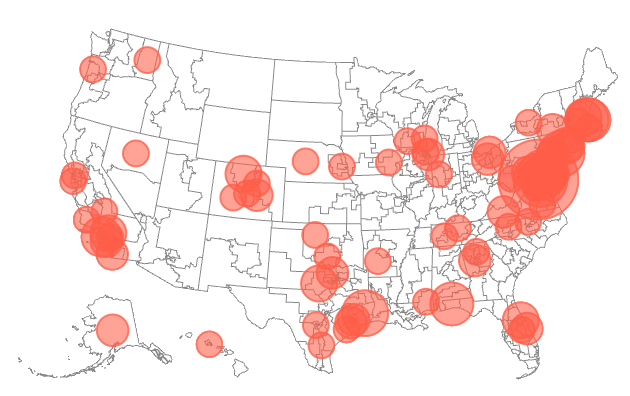
Explore real-time data about spending, contracts, and grants to see the economic impact of NASA science in every state and congressional districts.
Original Research and Analysis
We participate in the process of developing space policy by providing original analysis, releasing policy recommendations, and generating useful data for public and academic use.
Action Center
See all advocacy actions you can take.
