

 Explore Worlds
 Find Life
 Defend Earth


Meet the next generation of Mars exploration
The international missions that will explore the red planet


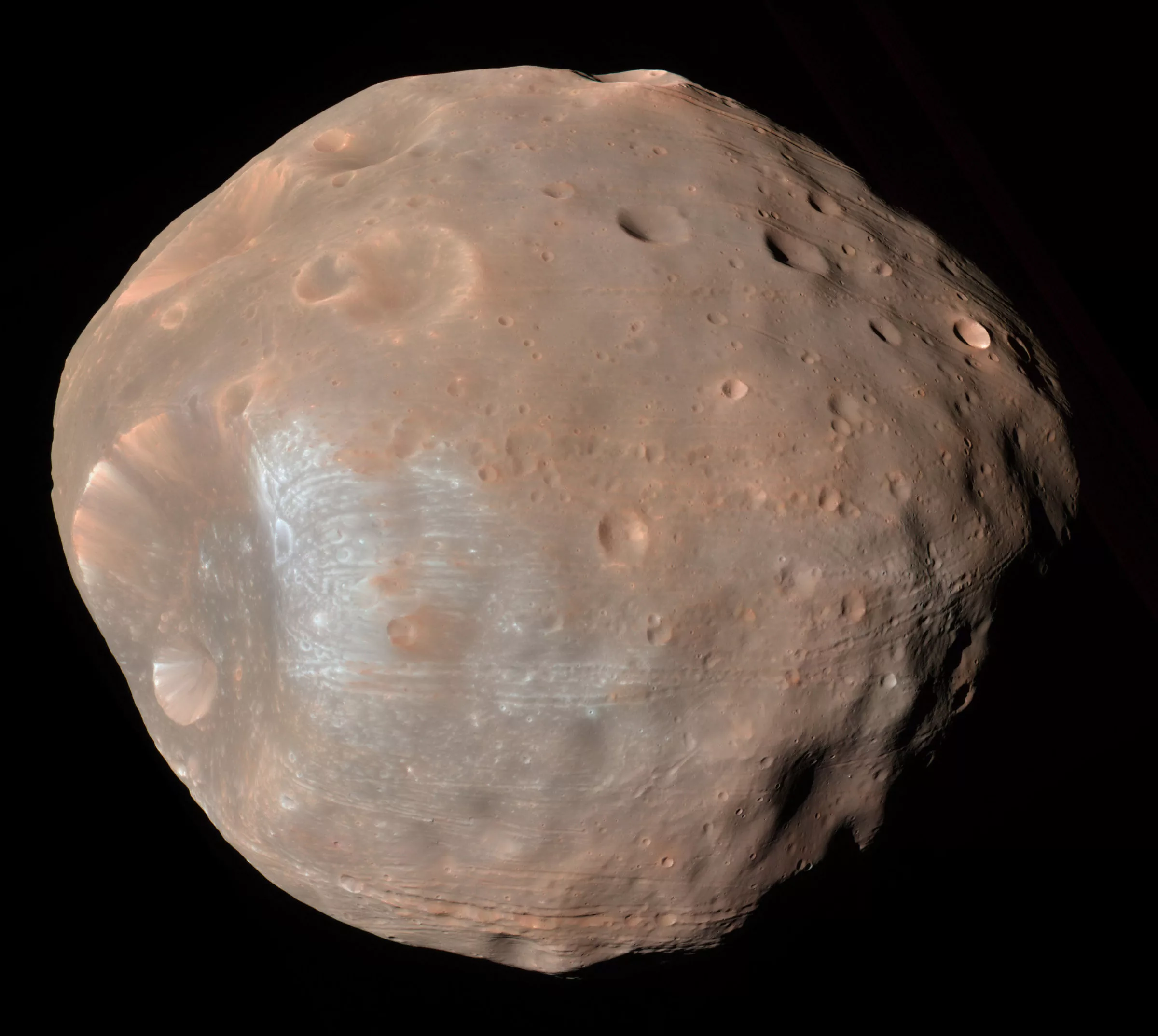
For decades, it has passed over Mars like a rumor, glimpsed only sparingly by rovers and orbiters, its shadowy face watching down over Mars’ vermilion seas of sand and dust in silence. Phobos, named after the Greek word for fear and a son of the god Mars, is the larger of Mars’ two moons, and soon, as part of a new wave of international missions, it will elude us no more.
Since the mid-1990s, Mars has enjoyed a steady beat of primarily NASA-led satellites, landers, and rovers focused on the search for water, habitability, and any evidence of past or present life. But recently, NASA’s focus has shifted. The ambitious Mars sample return program (MSR) has been put on an indefinite hold, and NASA’s three upcoming robotic missions to Mars, while sustaining the Mars momentum, have faced criticism from many in the science community. The opaque selection process for these missions has been a notable departure from the competitive, peer-led, and decadal survey-informed proposal review that has guided NASA in tackling the biggest scientific challenges in space for a generation.
Nonetheless, the SR-1 Freedom mission would achieve something NASA has been trying to do for 60 years by launching the first nuclear fission-powered interplanetary spacecraft. Its SkyFall payload would build on the success of the Ingenuity helicopter by sending three small helicopters to Mars equipped with cameras and ground-penetrating radars to map out future human landing sites.
The Mars Telecommunications Network (MTN) is a mission with special funding from Congress to enhance data transfer capabilities from Mars orbit. This infrastructure would be necessary for any high-throughput human communication from the surface.
Finally, the Aeolus mission is California-based Relativity Space’s effort to prove the viability of sending a SmallSat mission to Mars at low cost with private funds. The instruments it is launching, however, will be paid for and built by NASA. They include compact tools to measure Mars’ wind and track how it circulates heat across the planet.
While these missions from NASA appear to be designed primarily to pave the way for human landings and bolster commercial capabilities, other international players are ramping up their Mars programs with a focus on science. The United Arab Emirates and China have already emphatically entered the scene with the Hope probe and Tianwen-1 mission, respectively. And those are only just the beginning.
Three new international collaborations are poised to define the next half-decade of the scientific exploration of Mars. The China National Space Administration (CNSA) looks to return to the surface by 2030 and attempt a sample return with the Tianwen-3 lander and rotorcraft, although construction has only just begun, and public details are scarce. More concrete and launch-ready are plans from the European Space Agency (ESA) and the Japan Aerospace Exploration Agency (JAXA), with collaborative and ambitious science missions that will take us to a new surface region on Mars and for the first time to its moon Phobos.

MMX: Solving a 4-billion-year mystery
JAXA’s Martian Moons eXploration (MMX) mission will be the first to launch, as soon as November of this year. With contributions from NASA, ESA, CNES (France), and DLR (Germany), it will attempt something extraordinary: It will take a detailed look at — and the first taste of — a Martian moon. As it approaches Phobos, it will capture images and spectra with unprecedented detail to learn about its overall composition and structure. It will then deploy a small rover for fine-scale analysis and reconnaissance ahead of the main lander. Finally, using two different systems to make sure samples can be retrieved under the array of possible surface conditions, MMX will slurp up 10 grams of Phobos’ regolith and send it back to Earth. One of those systems is a small drill core reaching down to 2 centimeters. The other is the PlanetVac pneumatic sampling system that was developed with funding from Planetary Society members.
These samples could help answer questions that have been debated for decades, including those on the origin of Phobos and Mars’ other moon, Deimos. MMX-participating scientist Christopher Edwards explained that the primary tension concerns whether they are asteroids from the outer Solar System that were captured by Mars’ gravity or if they are debris left over from the formation of Mars. Visible and near-infrared spectral data of Phobos resemble the type of ancient asteroids that may have delivered water to the inner Solar System — but that’s not the full story. In recent thermal infrared images, Phobos looks increasingly like fine-grained Martian basalt. “Early Solar System dynamics are really in question,” said Edwards, and both hypotheses have implications for how the inner Solar System assembled and water ended up on Earth.
If Phobos is a captured asteroid, it can teach us about the primordial materials — organic molecules, minerals, and ices — that were available when rocky planets and life were first forming. If the material in Phobos comes from the early Martian crust, the samples collected by MMX could represent the best-preserved, least-altered samples ever obtained from the Mars system, standing out from other battered Martian meteorites that have landed on Earth. By studying samples of ancient Mars using mass spectrometers and electron microscopes back on Earth, scientists could paint an even more detailed picture of surface evolution and atmospheric composition through time.
MSR was originally proposed to do that, and more, for Mars. Although neither MMX samples nor the samples from China’s Tianwen-3 will achieve the full list of objectives set out for MSR, Edwards offered a valuable perspective: In the grand scheme of uncovering the Universe’s mysteries, “it’s way better to have a bunch of folks working toward the same goals than not.”
The Rosalind Franklin rover: Playing the long game
ESA’s ExoMars Rosalind Franklin rover is another example of international collaboration finally coming to fruition despite facing setbacks and uncertainty. After the mission was selected, the 2008 financial crisis nearly pushed ESA to terminate the project. That began the process of seeking more international support. NASA got involved … and then backed out. Russia got involved and launched the orbital component of the mission, the ExoMars Trace Gas Orbiter, in 2016, but with the war in Ukraine, that partnership ceased. Now, NASA is back in the picture, contributing a scientific payload, engineering components, and, most crucially, a confirmed launch contract for 2028.
ExoMars project scientist Jorge Vago first began thinking about an updated astrobiology-focused mission to Mars in the early 1990s as a graduate student at Cornell University. There, The Planetary Society’s co-founder Carl Sagan introduced him to the interdisciplinary partnerships that go into studying the origins of life (he also introduced him to his wife, who happened to be another student in one of Sagan’s courses). Today, Dr. Vago looks back on the persistence of the ExoMars program. He offered two explanations: “Firstly, the people involved in ExoMars, at all levels, have a tremendous drive. And secondly, the mission is genuinely interesting.”
The Rosalind Franklin rover will land in a region of Mars called Oxia Planum, adjacent to where the fictional characters in Andy Weir’s “The Martian” landed. A clay-rich region at the mouths of several channels that may have fed into an ancient northern ocean, it is the perfect laboratory for testing the possible origins of life.
Vago explained, “Mars is called a ‘terrestrial planet’ because it formed from the same ingredients as ours. However, it does not appear to have experienced plate tectonics — responsible for reforming most of our crust — and so, on Mars, it is possible to study the very early stages of planetary evolution, affording the conditions for life to appear on Earth. To do this, we need to target an ancient, water-rich location, and Oxia fits the bill.”
Unlike protagonist Mark Watney in “The Martian,” the Rosalind Franklin rover will drill into the Martian surface, reaching depths of up to 2 meters (6.5 feet), deeper than any surface mission has ever reached. The current record was set by NASA’s Viking lander, which dug to only 15 centimeters (6 inches) deep in 1976. Given the constant exposure of Mars’ surface to ionizing radiation, 2 meters beneath the surface just might be the refuge needed for soil microbes to survive.
The Rosalind Franklin rover will also assess for biosignatures using a state-of-the-art molecular analysis suite and a guiding framework that considers a cumulative case across multiple independent lines of evidence and multiple samples — the Sherlock Holmes approach to life detection. This is the part that “clicks” for Vago and links his work back to what he learned in class with Carl Sagan. All the pieces must fit together in a way that “cannot be explained away by anything other than life.”
What these missions mean for life on Earth
In the next five years, we may be closer to answering three of the most anticipated questions about Mars: How and when did Mars and its moons form? Is there evidence of life in Mars’ ancient northern channels? Where should humans take their first footsteps on the red planet? Extending beyond their science goals, MMX, Rosalind Franklin rover, Hope, and Tianwen-1 and 3 together also represent a shift in how discoveries are being made at Mars. NASA risks moving into a supporting role while others take the lead. While this may mean a challenging period for U.S.-based Mars scientists, the fact that more nations are committing resources means these questions are now more of a global priority than ever before, bigger than any single agency or budget cycle. The new faces arriving at Mars over the next half-decade are not just new flags; they are new instruments, refined questions, and a wider community insisting that these answers belong to everyone.
You Power the Next Great Discovery!
Fund future scientific research that advances space science and exploration with your gift today.
Donate
The Planetary Report • September Equinox
Help advance space science and exploration! Become a member of The Planetary Society and you'll receive the full PDF and print versions of The Planetary Report.