

 Explore Worlds
 Find Life
 Defend Earth
2026 Impact Report
In 2026, astronauts flew around the Moon for the first time in more than half a century. Through our industry-leading publications, The Planetary Society brought millions of people along for the ride. In this same year, the United States White House proposed cutting NASA science nearly in half, not once, but twice. Through both the triumphs and the threats, our community showed up to save NASA science. Throughout the year, we continued to inspire the public with the passion, beauty, and joy of space exploration through events, new partners, new technologies, and more.
2026 was also a year of new beginnings. Jenn Vaughn succeeded Bill Nye as CEO, and The Planetary Society launched “Together, We Explore,” a strategic vision built on four goals: to inspire, mobilize, lead, and thrive. The results below show what that vision looked like in its first year as the organization builds toward one of the most ambitious decades in its history.
Inspire
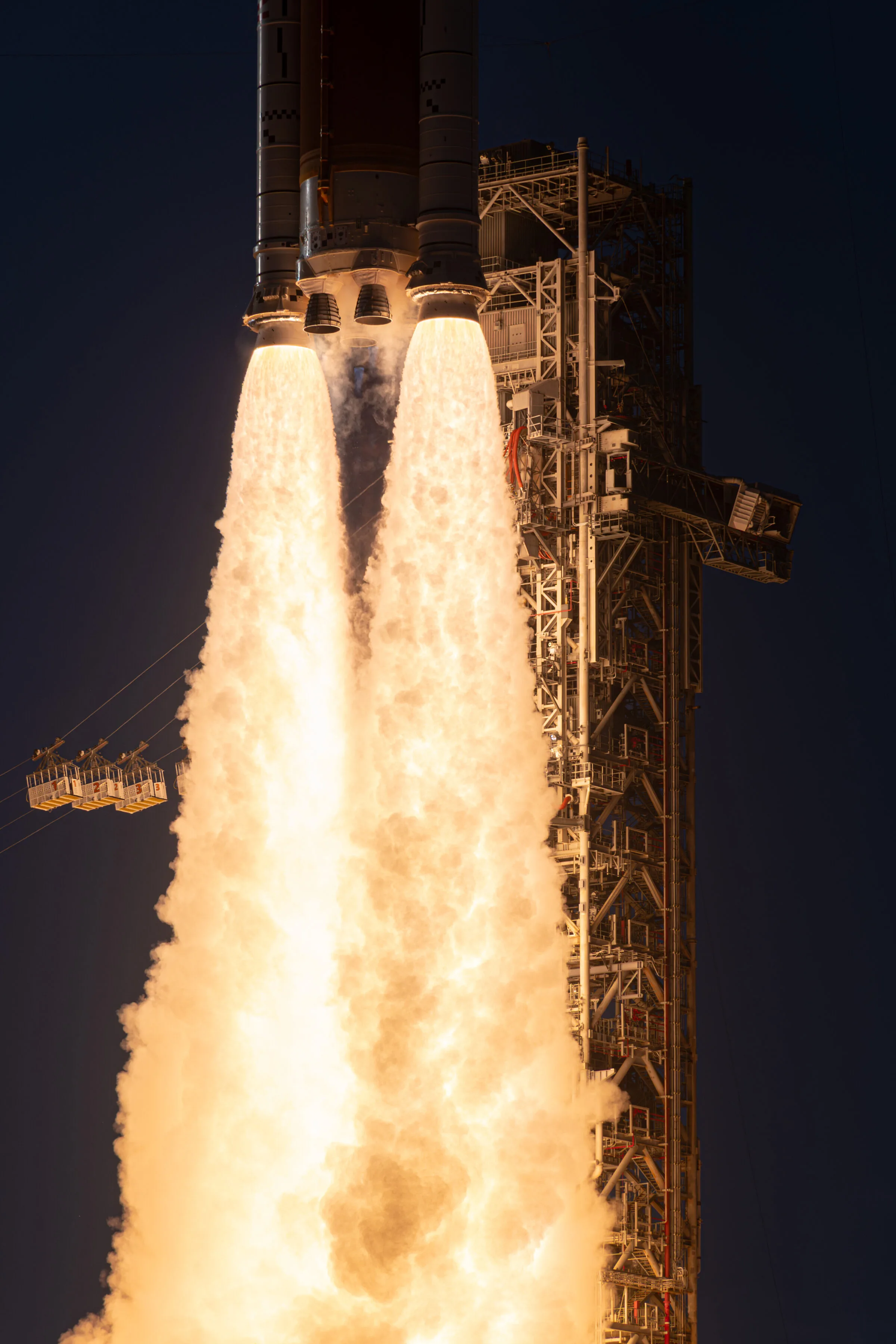
Our Artemis II coverage brought the return to the Moon to millions around the world
We covered Artemis II from every angle, from the science on board to the policy stakes around it. Our “We Watch Artemis” reaction video, filmed on the ground at Cape Canaveral, has reached 3.5 million views on Instagram and 1.5 million views on YouTube. Across both platforms, our Artemis videos drew more than 6 million views. Planetary Radio’s eight-episode Artemis series topped 99,000 downloads. Our experts made 37 TV appearances during the mission, including the policy team, who compared Artemis to Apollo on PBS NewsHour. As a result, April was our biggest traffic month of the fiscal year: new Artemis II coverage alone drew more than 174,000 views on the website.
Planetary Radio, Space Policy Edition, and Book Club Edition brought listeners closer to the people shaping space exploration
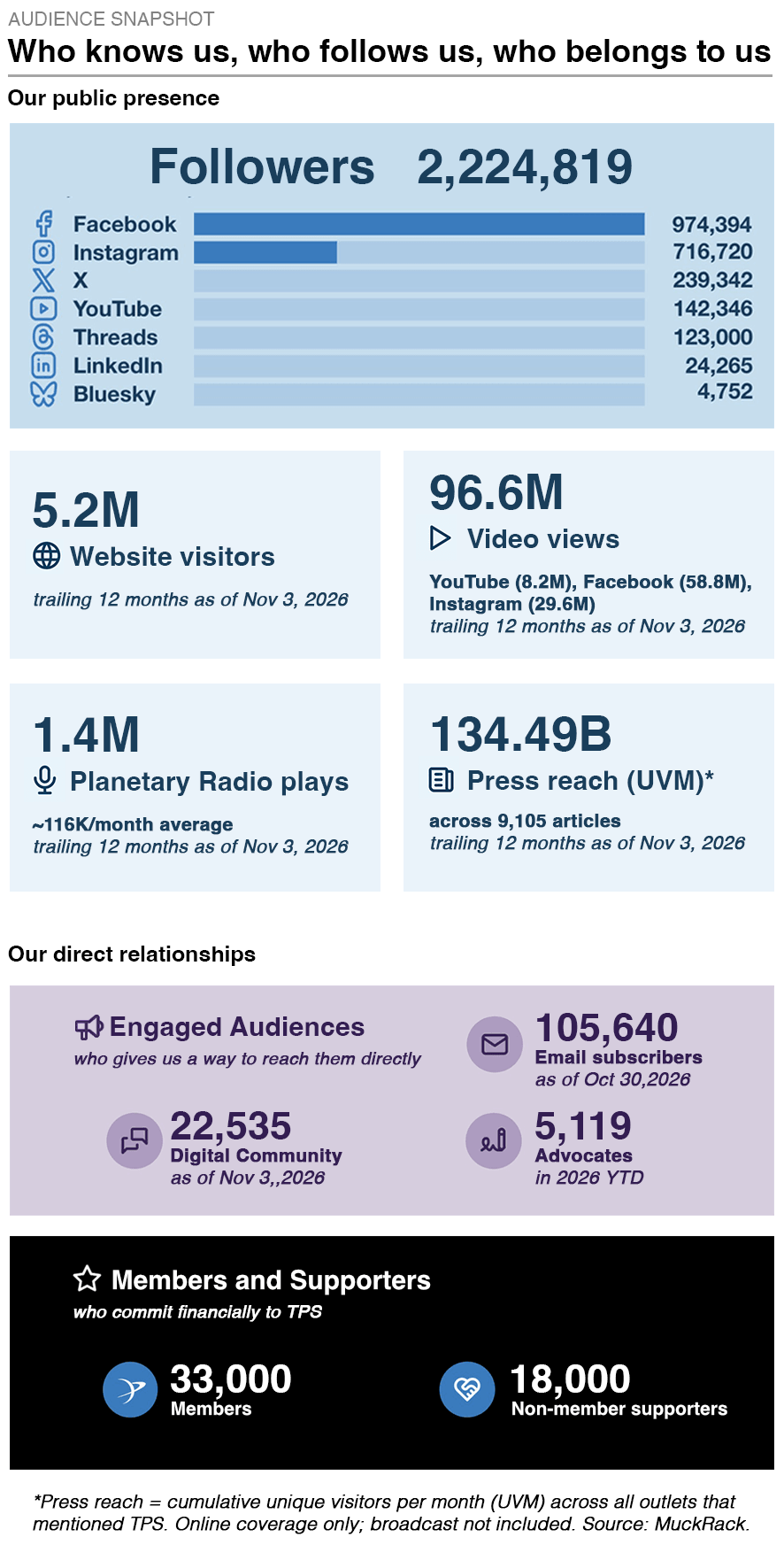
Planetary Radio host Sarah Al-Ahmed brought the latest in space science and technology to nearly 1.4 million listeners. Her guests included astronaut Eileen Collins, who discussed the documentary about her life, “Spacewoman,” and astrophotographer Andrew McCarthy, who previewed the August total solar eclipse. The show also went out into the world. It celebrated the Los Angeles Astronomical Society’s centennial star party at Griffith Observatory, and Al-Ahmed moderated a sold-out fireside chat with JPL Chief Scientist Jonathan Lunine, streamed live from JPL Mission Control.
On Space Policy Edition, Chief of Space Policy Casey Dreier talked with Alex MacDonald, NASA’s former chief economist; Marcia Smith, founder and editor of SpacePolicyOnline.com; and other influential voices in the field. Book Club Edition carried our members-only author conversations to a wider audience, with guests including Rocket Lab founder Sir Peter Beck, Hugo Award winner Becky Chambers, and NASA astronaut Leroy Chiao.

The Planetary Report took members from the Kuiper belt to the edge of interstellar space
Our quarterly magazine gave members an in-depth look at the year’s biggest stories in space exploration. The March issue explored comets and the Kuiper belt and introduced our new CEO, Jenn Vaughn. In June, just after Artemis II carried astronauts around the Moon, we asked what it could take for humans to reach Mars. September dove into the Nancy Grace Roman Space Telescope and the next generation of Mars missions. The December issue closed out 2026 with The Year in Pictures, a fold-out collection of the most striking space images of the past 12 months, along with an interview with space artist Don Davis about his painting celebrating Voyager 1’s journey to one light-day from Earth. Every issue also included updates on our advocacy, science and technology projects, and member stories.
We helped the world experience the Aug. 12 total solar eclipse in four languages
For the first total solar eclipse visible from Western Europe since 1999, we built a multilingual eclipse hub at planetary.org/eclipse. It had interactive maps from partner The Eclipse Company of Earth, safety guides, kids’ materials, and articles in English, French, German, and Spanish. We partnered with Mexican aerospace engineer Emasofía García on a Spanish-language video and with U.K.-based creator Andrea Henderson de la Fuente. Our resources were cited by CNN, CNN en Español, and USA Today and syndicated to dozens of outlets. Planetary Society staff appeared on ABC News Live and co-hosted SETI Institute’s eclipse livestream.

Our kids’ books with Lerner Publishing reached about 800,000 kids across U.S. libraries
In February, Chief Scientist Bruce Betts published “Are We Alone?” and “The Size of Space,” the latest in our series with Lerner Publishing Group. “Are We Alone?” introduces young readers to the search for life across the Universe. “The Size of Space” collects Bruce’s funny, memorable ways of shrinking the Solar System down to human scale. They join “Casting Shadows: Solar and Lunar Eclipses” and the 12-book Exploring Our Solar System series, for 15 titles in total.
Our Random Space Facts reached millions of young learners through Epic
Since 2022, The Planetary Society has partnered with Epic, an award-winning digital library of more than 40,000 books, audiobooks, and learning videos for children 12 and under. Through Epic, kids can watch Random Space Facts with our Chief Scientist Bruce Betts, whose funny, fascinating trivia covers everything from Solar System objects to space history and astrophysics. The videos have surpassed 2.2 million views, making space science fun and accessible for a new generation of explorers.

We celebrated global sky events such as International Observe the Moon Night and Asteroid Day
For Asteroid Day on June 30, Sarah Al-Ahmed joined science streamer Moohoodles on Twitch, bringing planetary defense to a new audience. On Sept. 19, The Planetary Society joined partners worldwide for International Observe the Moon Night. With Artemis II’s lunar flyby fresh in people’s minds, participation spanned 119 countries and all 50 U.S. states, with 4,162 registrations.
Mobilize
Members met CEO Jenn Vaughn face-to-face on the Member Roundtable Tour
In 2026, The Planetary Society traveled to eight cities across the U.S. and met with 180 members in person. Stops included Orlando, Tempe, Washington, D.C., Chicago, San Diego, the San Francisco Bay Area, Boulder, and Pasadena. Members got a first look at The Planetary Society’s new five-year strategic vision and helped shape it with their own ideas.
Our digital member community kept members connected to The Planetary Society’s mission all year
In 2026, we hosted 19 live events in our digital community, where Planetary Society members can connect with like-minded space enthusiasts. Our book club was especially active, with 12 live author conversations and picks spanning children’s books, poetry, science fiction, and memoir. Seven more virtual livestreams brought members together around the year’s biggest moments, including a screening of “Small Town Universe” with director Katie Dellamaggiore. During Artemis II, 335 members joined our live chat events. We also launched a new course showing members how to share their passion for space exploration in their own communities.
The Downlink delivered space news to more than 100,000 inboxes every week
Our free weekly newsletter gave readers a quick but substantive way to keep up with the latest in space science and exploration. Each issue paired a striking Space Snapshot with the week’s biggest news, a Fact Worth Sharing, and ways to get involved with The Planetary Society. When Artemis II flew around the Moon, The Downlink brought readers the crew’s view of Earth setting behind the lunar farside and pointed them to our live mission coverage. Readers also turned to it throughout the year for calls to action in the fight to save NASA science.
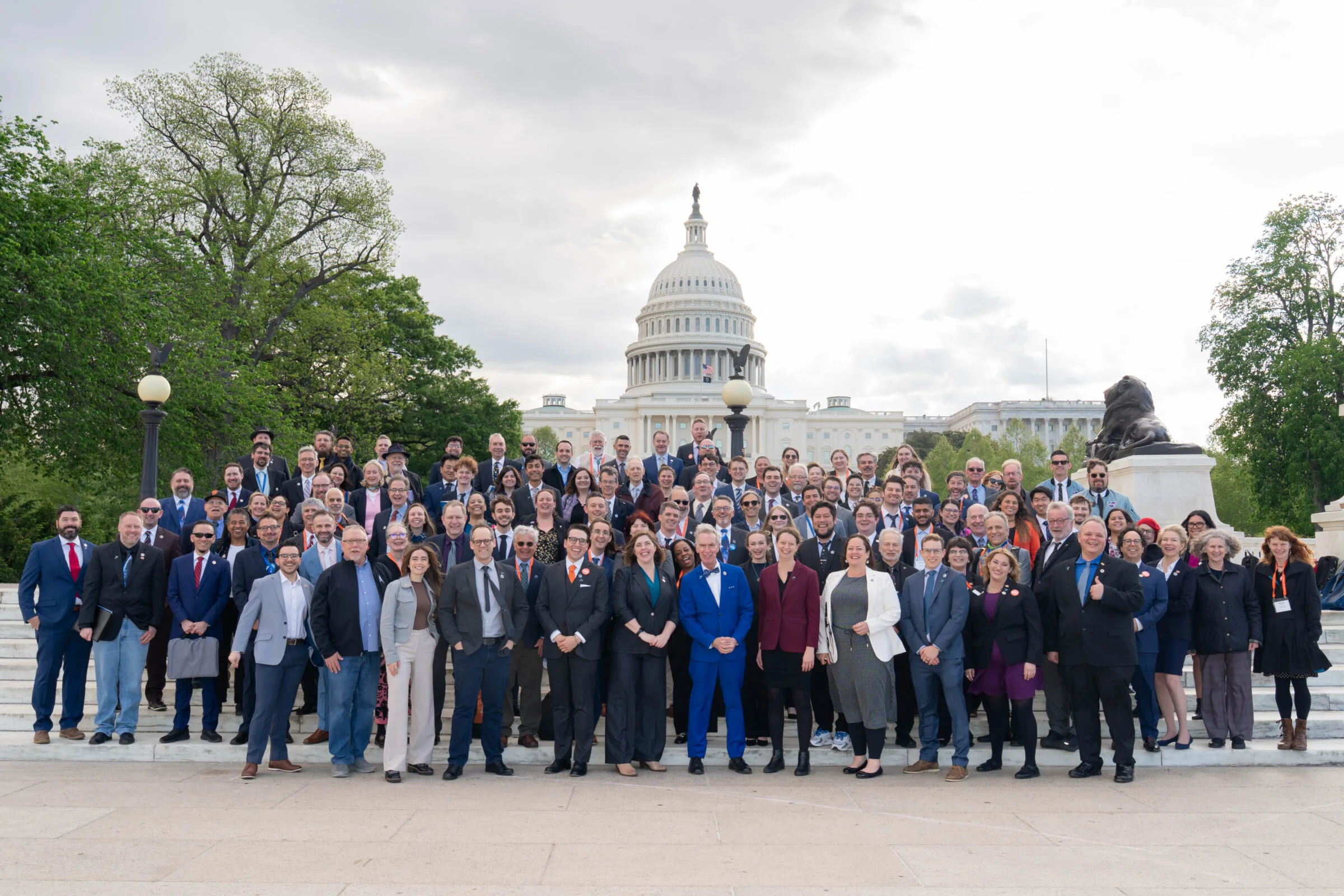
More than 130 advocates met with Congress on the April 20 Day of Action
On April 20, Planetary Society members from 34 states and D.C. held 280 meetings with House and Senate offices to oppose the White House’s proposed 46% cut to NASA science. Days before the first House budget hearings, they urged Congress to fund NASA science at $9 billion and helped add four new members to the Planetary Science Caucus.
Members took action from home, too
Members didn’t have to travel to Washington, D.C., to make a difference. This year, Planetary Society supporters sent 13,431 messages and public comments to lawmakers and federal officials. They pushed Congress to pass a continuing resolution early in the year, then urged their representatives and senators to sign bipartisan letters calling for $9 billion for NASA science. Since April, 3,765 people have joined eight of our advocacy actions. Supporters also filed public comments opposing a White House proposal that would have let political appointees override scientific peer review in federal grantmaking. The proposal drew more than 160,000 comments in all, more than 95% of them opposed, and Congress later blocked the full rule changes through mid-December.
We trained the next generation of science advocates
Jack Kiraly brought advocacy training to scientists, students and space workers across the country. At the Astrobiology Science Conference (AbSciCon) in Madison, Wisconsin, he co-led a “Working with Congress” training with AGU that taught scientists how the legislative process shapes funding for space science and how to engage with their representatives. He also led trainings at Boise State University and the University of Maryland in College Park, and at the Planetary Science Institute’s retreat in Tucson, Arizona. Space workers took part too, with sessions for JPL Workers United in Pasadena, California, and the Goddard Family Alliance in Greenbelt, Maryland. AAAS Fellow Ari Koeppel led advocacy trainings for a Students for the Exploration and Development of Space (SEDS) group and for the Lunar and Planetary Institute’s summer interns.
Members are funding the next phase of a search for life project
With a 2023 STEP Grant, Dr. Jacob Buffo of Dartmouth College and his team made four expeditions to British Columbia’s hypersaline lakes. The lakes’ chemistry mirrors ancient Mars and the hidden oceans of Europa and Enceladus, and the team collected more than 400 samples. This fall, members began funding Phase 2: AI tools that could help future spacecraft spot the most promising places to search for life in real time, to be tested at Mono Lake and Great Salt Lake.
Lead
The Planetary Society led the fight to save NASA science, and kept fighting
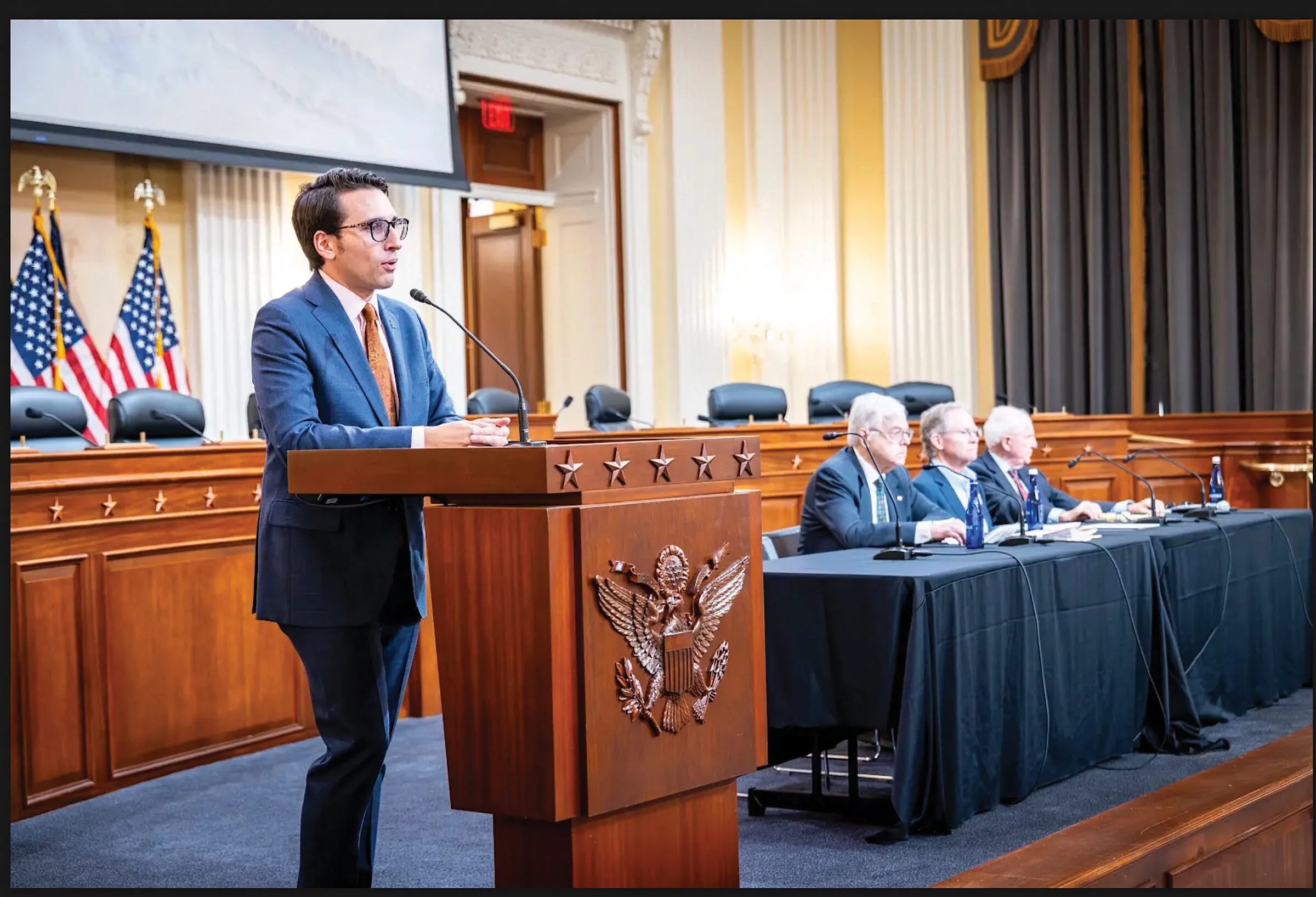
The White House’s FY2026 budget proposed the largest single-year cuts in NASA’s history, including a 47% cut to NASA science. Led by Casey Dreier, Jack Kiraly, and Ari Koeppel, The Planetary Society mobilized tens of thousands of people, who sent hundreds of thousands of messages to Congress. Congress rejected the cuts and fully funded NASA through H.R. 6938, signed into law on Jan. 23, 2026.
Weeks later, NASA science was under threat again. The FY2027 request again proposed cutting NASA to $18.8 billion, its smallest budget since 1961, including a 46% cut to science. We relaunched Save NASA Science and identified 84 missions at risk, more than 50 of them slated for cancellation, including New Horizons, Juno, and DAVINCI. Among them was NASA’s contributions to ESA’s Rosalind Franklin Mars rover, which have stranded the mission and that we warned would make NASA “an unreliable partner.”
We backed bipartisan letters from 103 House members and 22 senators asking for $9 billion for NASA science. Our advocates carried that ask into 280 congressional meetings during our Day of Action. When the White House moved to let political appointees override peer review, our members helped generate more than 160,000 comments, and Congress temporarily blocked the full rule changes from going through.
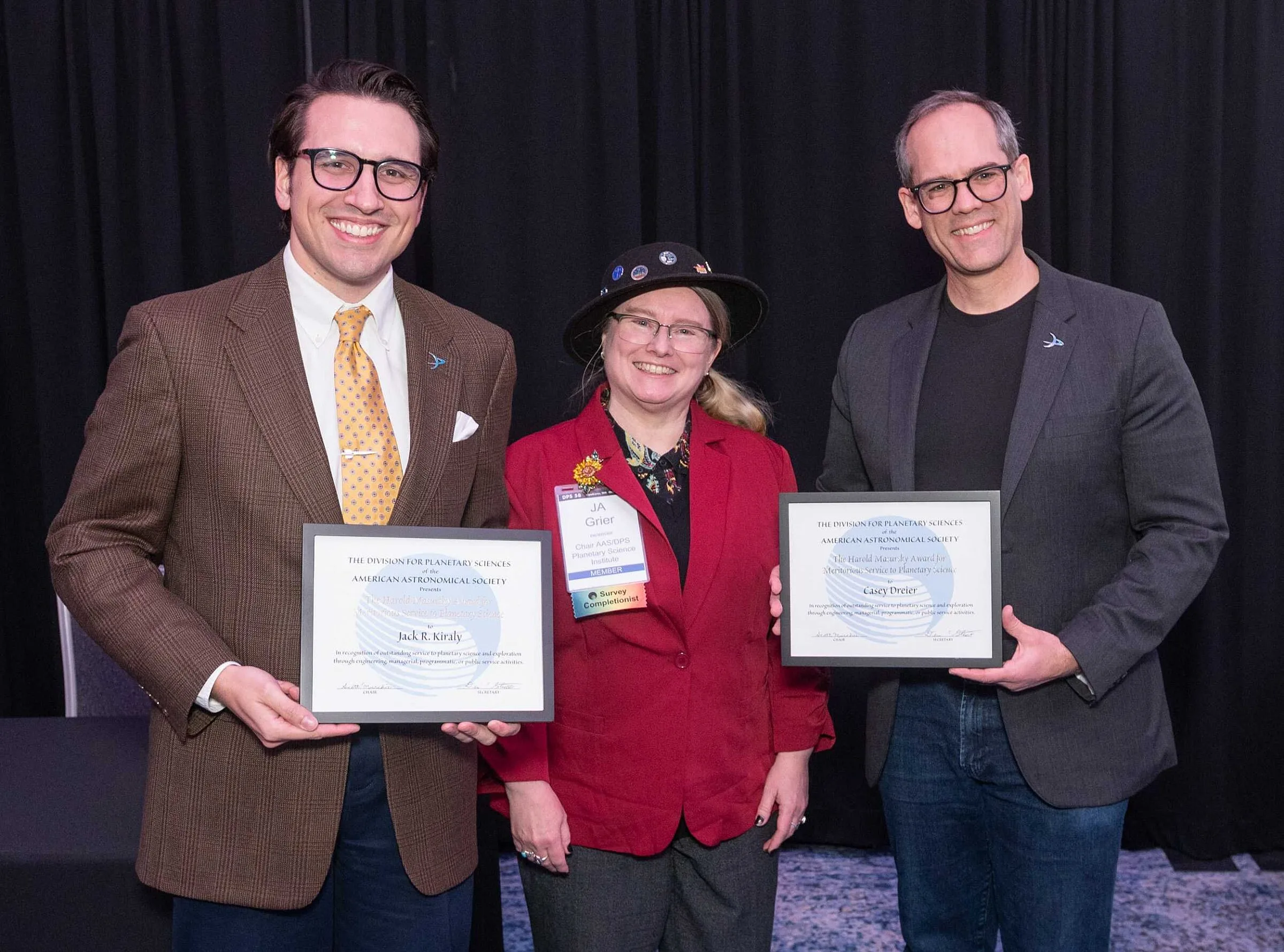
In recognition of this work, Casey Dreier and Jack Kiraly received the 2026 Harold Masursky Award from the AAS Division for Planetary Sciences, which honors exceptional service to planetary science.
We funded three new STEP Grant projects to advance planetary science and defense
Our 2026 STEP Grants awarded $129,673 through an open international call:
- A Solar System shadow-tracker: Mike Kretlow of the German Center for Astrophysics received $30,000 to expand CORA, a tool that predicts stellar occultations. The upgrade will let it handle the tens of thousands of small worlds the Vera C. Rubin Observatory is expected to discover, so observers with modest telescopes can measure their size and shape.
- An affordable asteroid polarimeter: Nicholas Moskovitz of Lowell Observatory and Northern Arizona University received $49,593 to build a low-cost polarimeter from off-the-shelf and 3D-printed parts. It will measure how reflective asteroids are, sharpening the size estimates that tell us which ones could threaten Earth.
- A public asteroid database: Miguel R. Alarcon of Light Bridges, affiliated with Spain’s Instituto de Astrofísica de Canarias, received $50,080 for AsteroiDB. It’s a public platform for asteroid brightness measurements that reveal shape, size, and structure, and its pilot already holds more than 11 million measurements.
Past grantees show what’s possible with this resource. Florida Tech’s Andrew Palmer turned a 2023 STEP Grant for growing crops in lunar soil into three peer-reviewed papers and new NASA funding.
Member-funded technology is headed to Mars’ moon Phobos
The P-Sampler instrument launched aboard JAXA’s Martian Moons eXploration (MMX) mission in October. Built by Honeybee Robotics and contributed by NASA, it uses a puff of gas to blow surface material into a collection container. P-Sampler is the next version of PlanetVac, for which Planetary Society members helped fund the first key tests.

We represented The Planetary Society at public and scientific events around the world
In June, Planetary Society staff hosted an interactive exhibit at Pasadena’s City of Astronomy festival. Then, in October, Public Outreach Astronomer Asa Stahl, Chief of Advocacy Jack Kiraly, and Chief of Space Policy Casey Dreier joined the 58th Annual Meeting of the American Astronomical Society’s Division for Planetary Sciences (DPS) in Spokane, Washington. Casey attended COSPAR in Florence, Italy; presented to the National Academies Space Studies Board; and chaired a panel on JPL’s 90th anniversary at Caltech.

A Planetary Society grant helped make a record-breaking comet discovery
Using cameras funded by a Shoemaker NEO Grant, grantee Alain Maury and collaborators from France and the U.S. spotted sungrazing comet C/2026 A1 (MAPS) from Chile’s Atacama Desert. It was the earliest detection of a Kreutz sungrazer on record.
We convened scientists, policymakers, and partners on Capitol Hill
- Igniting Discovery: On April 21, the day after the Day of Action, we and seven partners, including AGU, AAS, and the Association of American Universities, co-hosted a showcase of about 20 exhibitors. They showed policymakers NASA-funded work across all five science divisions, making the case that “NASA Science touches every state.”
- Partners in Discovery: The Planetary Society partnered with Arizona State University and the Commercial Space Federation to convene Partners in Discovery, a workshop held Aug. 31–Sept. 2, 2026, in Washington, D.C., that brought together leaders from government, academia, and the commercial space industry to explore new ways of working together to advance NASA science.
- Educating Congress: AAAS Policy Fellow Ari Koeppel joined Society Board President Bethany Ehlmann to lead a congressional staff briefing on lunar science, walking staff through the key science objectives the Moon can answer and why they matter ahead of the Artemis II mission. The briefing was part of a series of lunch-and-learns, organized in conjunction with the Congressional Planetary Science Caucus, which also covered the AVATAR experiment and Mars missions.
- Celebrating Viking at 50: On July 20, 50 years to the day after Viking 1 touched down on Mars, The Planetary Society co-hosted an event on Capitol Hill with Johns Hopkins University, the Smithsonian National Air and Space Museum, SpaceNews, and the Congressional Planetary Science Caucus. The event looked back on the first successful U.S. landing on Mars and hosted a discussion on the far future of crewed and robotic Mars exploration.
Our study of more than 100 NASA science missions was covered by Science
Casey Dreier and Ari Koeppel analyzed three decades of NASA science missions and found that mid-cost missions deliver the best balance of cost, reliability, speed, and scientific output. The cheapest missions failed most often and produced the fewest high-impact results. Presented at LPSC and covered by Science, the study gives policymakers hard evidence that cutting mission budgets doesn’t save science.
Thrive

Jenn Vaughn was appointed CEO, and Bill Nye became Chief Ambassador
Vaughn joined the Society in 1996 as an editorial assistant and rose through the ranks, serving as managing editor of The Planetary Report, director of publications, and chief operating officer. She has been key to shaping the organization’s growth, from LightSail to the fight to save NASA science. Nye became chief ambassador and vice chairman of the board, and he continues to represent The Planetary Society publicly and in Congress. Members celebrated the transition at a live Q&A with both leaders in March.
We launched a new strategic vision to guide our next chapter
In 2026, The Planetary Society introduced “Together, We Explore,” a new strategic vision that will shape our work through 2030. It rests on four goals: to inspire, mobilize, lead, and thrive. The vision is grounded in six core values: curiosity, humanity, optimism, independence, credibility, and effectiveness.
To bring the strategic vision to life, we reorganized our teams
Our new Programs department brings education and public outreach, science and technology projects, space policy and advocacy, and member engagement under one roof. Advancement, formerly Development, now also includes marketing and institutional communications. Administration, formerly Finance, now also covers human resources and systems administration.
New partnerships expanded our reach and resources
Partners helped us bring space to new audiences and raise support for our mission. Our Celestial Escape to Mauna Kea sweepstakes, run with TapKat and supported by Mauna Kea Resort, The Westin Hapuna Beach Resort, Keck Observatory, and Hawaii Forest & Trail, drew 11,788 entries and raised $542,800. Through our partnership with Colossal, The Planetary Society was the beneficiary of America’s Favorite Teacher and America’s Favorite Student, national competitions that raised $4.8 million. The Heising-Simons Foundation awarded The Society a $500,000 grant to support our policy and advocacy work. For the Aug. 12 total solar eclipse, The Eclipse Company of Earth provided interactive maps that helped audiences around the world plan where to watch.
We built a stronger foundation to grow our impact
Behind the scenes, we invested in the practices and tools that will carry The Planetary Society into its next chapter. We launched Momentum, a new fundraising newsletter that shows supporters how their generosity moves our mission forward. We adopted an organizational AI policy that guides staff in using new technologies thoughtfully and responsibly, consistent with our core value of credibility. And we optimized our Salesforce system to better connect with members and donors, giving us a platform built to scale as we grow.
2026 Platinum seal from Candid and 4 stars from Charity Navigator

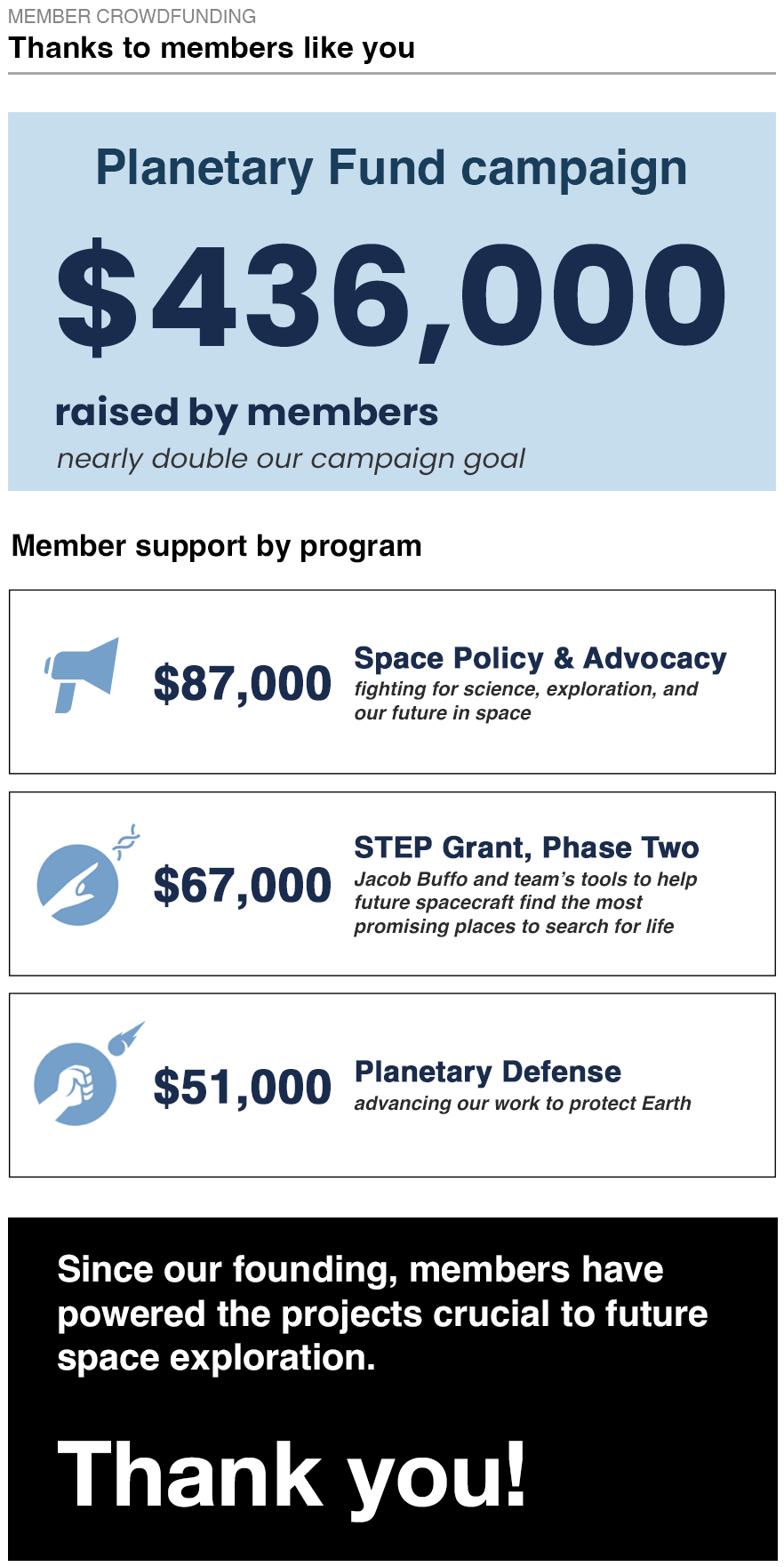
This work would not be possible without our members and donors. If you are not already, please consider joining us today and supporting a future full of scientific space exploration.
