

 Explore Worlds
 Find Life
 Defend Earth

Highlights
- PlanetVac is a Planetary Society-supported technology that has landed on the Moon and, in October 2026, will launch to Mars.
- By collecting samples of other worlds more efficiently than past technologies, PlanetVac could revolutionize how we explore the Solar System.
- PlanetVac’s missions are one of the first instances of a non-profit, powered by regular people, helping to develop a space exploration technology that has landed on another world.
Why PlanetVac?
Some of the greatest discoveries in the history of space exploration came from picking up pieces of other worlds. Rocks brought back by the Apollo astronauts taught us that the Moon likely formed from a giant impact with Earth, and specimens of asteroids have shown us that they could have supplied much of Earth’s water. As you read this, there are samples waiting to be returned from Mars that might confirm whether the red planet has ever been hospitable to life.
PlanetVac operates on the Moon Honeybee Robotic's Lunar PlanetVac instrument successfully collects a sample of regolith from the Moon's surface. Lunar PlanetVac touched down as part of Firefly Aerospace's Blue Ghost Mission 1 on March 2, 2025.Video: Firefly Aerospace
But sampling is hard and expensive to pull off. Spacecraft have made it all the way to Venus and the Moon, landed, and then failed at this step. Many sampling missions today rely on what are essentially robotic arms, which tend to be complicated and must be designed almost perfectly to make sure they work on other worlds. That in turn makes sample missions more expensive, risky, and rare. More than 70 robotic missions have been sent to the Moon, for example, but fewer than 10 have picked anything up.
The Planetary Society, as part of our longstanding efforts to support important work that furthers the scientific exploration of space, identified PlanetVac as a promising tool for overcoming these issues. Our members and supporters funded tests of PlanetVac in 2013 and 2018, helping its creator, space technology company Honeybee Robotics*, prove that PlanetVac could work.
In 2021, NASA affirmed the potential of PlanetVac by selecting a version of it as one of the instruments onboard Firefly Aerospace’s Blue Ghost Mission 1, which landed on the Moon in 2025. The Japan Aerospace Exploration Agency has installed a Honeybee Robotics derivative of PlanetVac on its Martian Moons eXploration (MMX) spacecraft, a mission to bring back the first-ever samples from Mars’ moon Phobos.

How PlanetVac works
Picture a dustbuster attached to the landing leg of a spacecraft, and you won’t be far off. But instead of sucking material in, PlanetVac blasts out pure nitrogen gas. It does this in just the right way to stir the dirt and rocks below into a tiny tornado, then gives another puff to sweep that lifted material up into a collection chamber.
The result is lightweight, low-cost, and efficient. In its simplest form, PlanetVac has just one moving part (the valve that opens to release the gas), which means it draws much less power than traditional systems and is less likely to fail. And unlike a robotic arm, which can only work if it’s fitted onto a lander in certain places, PlanetVac can be attached almost anywhere. It doesn’t need to touch the ground to work, just come close, and it can operate on many different kinds of worlds regardless of their gravity or rocky makeup.
Robotic arms will still be more useful in some situations. PlanetVac isn’t designed for large rocks, for example, and it can’t drill, scrape, or select a particular sampling site if it’s on a lander that can’t move. But for many kinds of science — and especially for missions where reliability matters most — PlanetVac could be a game-changer.
PlanetVac Testing on Xodiac Rocket In 2018, Planetary Society members and supporters helped fund a test of the PlanetVac sample collection technology aboard a rocket called Xodiac. Xodiac, built by Masten Space Systems, takes off and lands vertically in California's Mojave Desert, allowing hardware developers to simulate the stresses of a rocket launch and landing. PlanetVac was attached to the rocket’s leg and successfully collected 332 grams of simulated Martian soil.
The Planetary Society’s role
If it weren’t for The Planetary Society’s help on two separate, crucial occasions, PlanetVac might not have launched to the Moon and Mars.
The first turning point came in 2013. At that time, Honeybee Robotics had only tested parts of PlanetVac, and while NASA had partially funded the project, there weren’t enough resources to build a full prototype.
The Planetary Society took notice. As part of our mission of advancing the scientific exploration of space, we find and support innovative science and technology projects — and according to Bruce Betts, chief scientist at The Planetary Society, PlanetVac immediately stood out as a candidate. It was practical, it had a chance of flying in the very near future, and it needed help. The Society had already worked with Honeybee on other projects, and Honeybee had a history of building successful hardware for several Mars missions.

Our members pitched in to fund PlanetVac’s first complete prototype and a lab test in simulated Mars conditions. Inside a phonebooth-sized vacuum chamber that mimicked the thin Martian atmosphere, PlanetVac funneled Mars-like dirt into a collection chamber and a non-functional rocket (though Honeybee did joke about making the rocket fly across Pasadena and deliver its sample to Planetary Society headquarters). The PlanetVac team repeated these tests in conditions meant to mimic those on the Moon, as well. In all cases, the prototype was a success.
NASA soon awarded Honeybee Robotics another grant. This time, the team would aim to demonstrate that PlanetVac could work on an actual rocket.
Again, funding from Planetary Society members pushed this test to the finish line. In 2018, we helped Honeybee take PlanetVac out on a test flight aboard a Xodiac rocket, one that would subject the instrument to the heat, shaking, and stress of a real launch and landing. PlanetVac launched from the Mojave Air and Space Port, touched down in Mars-like soil, and successfully collected three times more rocks than its original goal. The flight proved that PlanetVac could work in the field, making it much more likely to be selected for a mission in the future.

PlanetVac makes for the Moon and Mars
In 2025, PlanetVac landed on the Moon onboard Blue Ghost, a private lunar lander built by Firefly Aerospace and funded by NASA as part of the agency’s Commercial Lunar Payload Services program.
Though this mission didn’t bring back any samples or run any scientific experiments on what it collected, it provided the first demonstration of PlanetVac in space. Even though the leg of the spacecraft that PlanetVac was attached to did not fully touch the ground, PlanetVac still captured more than five times the amount required to declare its mission a success. An onboard laser and camera checked that it had successfully brought samples into the lander, and the lunar soil that PlanetVac collected was sorted into bits of different sizes, just as a future mission might do before taking scientific measurements.
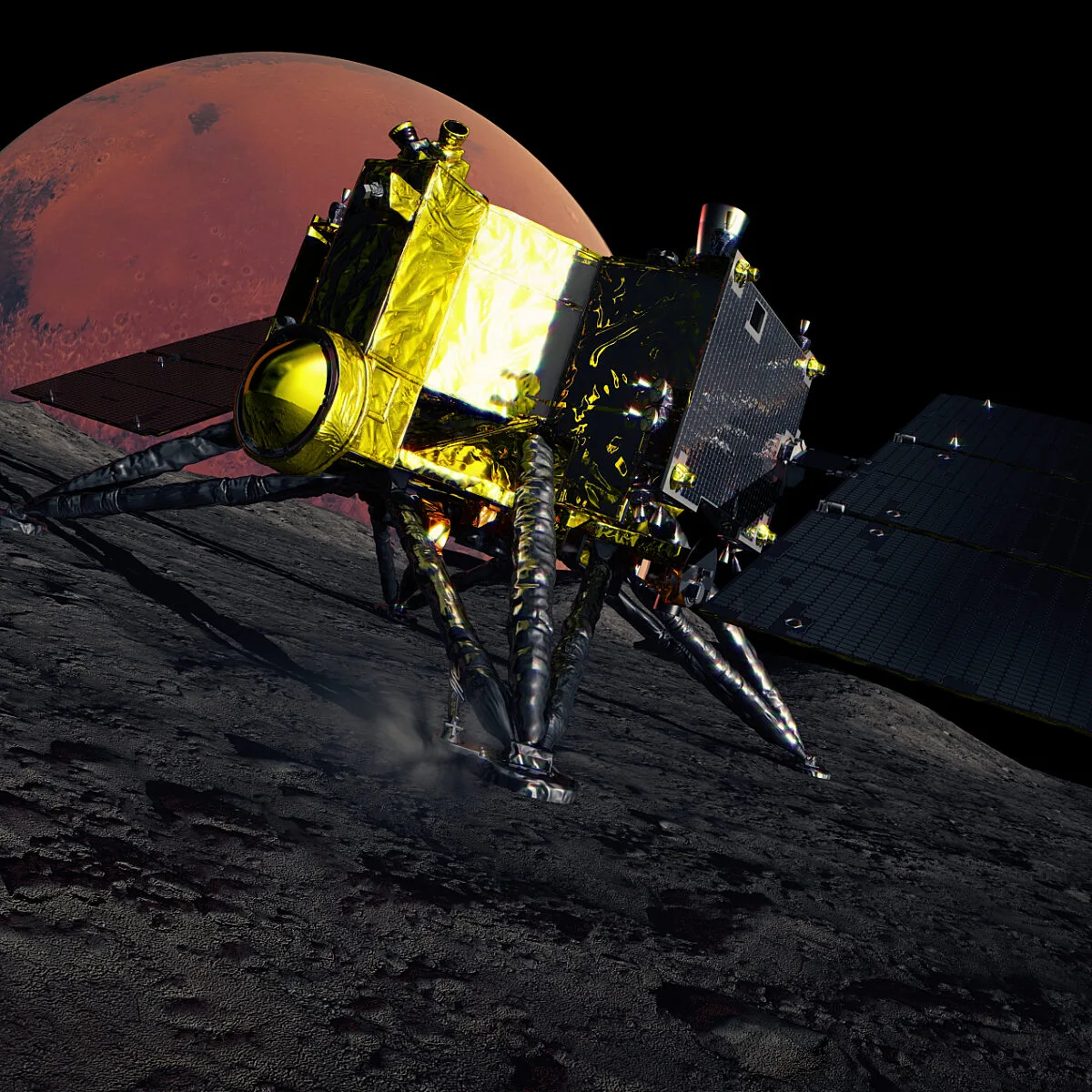
PlanetVac is also set to fly beyond the Moon. A version of PlanetVac called “P sampler” will play a key role in JAXA’s Martian Moons eXploration (MMX) mission to bring back the first-ever samples from Phobos, a moon of Mars. The spacecraft will also use a second sampling system based on a more traditional robotic arm, but since we don’t quite know what the surface of Phobos is like, NASA contributed P Sampler to the mission to help ensure it collects samples no matter what. These samples are expected to reveal where Phobos came from and other insights about early Mars. The goal is for the samples to return to Earth in 2031.

Timeline
- Oct. 30, 2012: The Planetary Society announces its partnership with PlanetVac.
- July 1, 2013: Members of The Planetary Society successfully raise $30,000 to help test PlanetVac.
- Dec. 4, 2013: The first full end-to-end tests of PlanetVac, supported by The Planetary Society, are a complete success.
- March 6, 2014: The project leader for PlanetVac at Honeybee Robotics, Kris Zacny, presents the results of their test at the annual IEEE Aerospace Conference. He receives initial signs of interest in sending PlanetVac to Mars.
- Spring 2018: In a campaign organized by The Planetary Society, over 800 people from 35 countries donate to support another test of PlanetVac. Pendleton Ward, creator of the TV show Adventure time, and Dustin Roberts generously contributed matching funds.
- May 2018: PlanetVac launches for a successful test onboard a Xodiac rocket at the Mojave Air and Space Port. Planetary Society members and supporters, including Pendleton Ward, are in attendance.
- July 1, 2019: NASA selects PlanetVac as one of a dozen science and technology payloads to receive first-phase funding in preparation for a possible flight to the Moon as part of the Commercial Lunar Payload Services program.
- Feb. 19, 2020: JAXA announces P-Sampler, an iteration of PlanetVac, will fly to Phobos as one of the instruments onboard the MMX spacecraft. The agency officially names MMX as a “JAXA Project,” marking a transition to mission hardware and software development.
- Feb. 4, 2021: NASA announces Lunar PlanetVac as one of the payloads that will be carried onboard Firefly Aerospace’s Blue Ghost Mission 1 to help study the Moon and explore its surface.
- Jan. 15, 2025: Blue Ghost Mission 1 launches to the Moon with Lunar PlanetVac onboard.
- March 2, 2025: PlanetVac lands on the Moon onboard Firefly Aerospace’s Blue Ghost Mission 1. It operates successfully.
- Oct. 19, 2026: MMX scheduled to launch to Phobos with P-Sampler onboard.
- 2027: MMX projected to arrive at Mars and begin science operations.
- 2031: MMX projected to return samples of Phobos to Earth.
PlanetVac, Assemble! A new low-cost, reliable approach to sampling planetary surfaces. Help this technology through the next level of testing for consideration on future missions!
What can you do to support PlanetVac?
Carl Sagan co-founded The Planetary Society to give you a role in space exploration. Sharing PlanetVac’s story and contributing to other projects like it helps enable future space science discoveries. If you’re not a member of The Planetary Society, consider joining to learn about other opportunities and help take action to further the scientific exploration of space.
Learn more
- Tune into the PlanetVac rocket test of 2018 on this episode of our Planetary Radio podcast, watch a video tour of Honeybee Robotics, or hear from the project lead for PlanetVac, Kris Zacny
- Find out why sample return missions like OSIRIS-REx and Hayabusa2 are so important, and learn about the ambitious effort to return samples of Mars to Earth for the first time
- Stay up to date on our science and technology projects by signing up for The Downlink, our weekly newsletter
- Learn about our sci-tech program and explore our past and present projects
- Dive into a paper on the PlanetVac MMX mission published for the 2020 Institute of Electrical and Electronics Engineers 2020 Aerospace Conference
*Honeybee Robotics was bought by Blue Origin in 2022.

Action Center
Whether it's advocating, teaching, inspiring, or learning, you can do something for space, right now. Let's get to work.
PlanetVac Image Gallery



Recent articles about PlanetVac

The Planetary Society’s role in real space missions
Since 1980, The Planetary Society has been active in over 20 space exploration missions, from leading public outreach efforts to funding the development of instruments.

Tech funded by Planetary Society launches to the Moon next month
A spacecraft trying to land on the Moon will carry PlanetVac, the lunar dustbuster that could change how we explore other worlds.

What to look forward to in space in 2024
A total solar eclipse and the launch of Europa Clipper are on our list of cosmic events to get excited about this year.
Recent Planetary Radio episodes about PlanetVac

Planetary Radio looks back at the biggest space exploration stories of 2025, from stunning images and major missions to hard lessons about how science moves forward. Host Sarah Al-Ahmed is joined by members of The Planetary Society’s communications team to reflect on what defined the year, and what they’re most excited to see in 2026.

A reported 50% cut to NASA’s science budget threatens to shut down missions, halt new discoveries, and devastate scientific space exploration. This week, we break down the fight ahead with The Planetary Society’s space policy team and explore how grassroots advocacy can help protect the future of space science.

A distant, lonely planet has been discovered as it wanders the galaxy, while Bill Nye helps us celebrate selection of a radically-simple sample collection system for trips to the Moon and Mars’ moon Phobos.